

A history of the ballet flat: from Regency slippers to 2026
The ballet flat is and has always been in style. Women have been wearing flat, soft-soled shoes for over two hundred years, and the shape has resurfaced in almost every generation since. Looking at where the shoe came from makes it easier to understand why the current version sits where it does, and what separates a ballet flat built to last from one designed for a single season.
This post traces the history of the flat women's shoe through the moments that shaped it: the Regency slipper, the ballet influence in 1832, the 1920s Mary Jane, the 1940s American crossover that turned the ballet slipper into a street shoe, the 1950s Hepburn and Bardot moments that made it globally famous, the early 2000s revival, and the current resurgence. Each generation found a use for a heelless, soft-soled, low-vamp leather shoe, and the construction principles that made the shoe work in 1810 are the same ones that make a well-built version work now.
The Regency slipper (c.1795 to 1830)
The flat women's shoe as a recognisable form emerged in the late Georgian and Regency period, when the heeled court shoes of the eighteenth century gave way to something far simpler. Neoclassical taste was driving the broader shift in women's fashion at the time, with high-waisted muslin dresses replacing structured silk gowns, and footwear followed the same logic with heels disappearing, decoration scaled back, and construction softened.

Merry-Joseph Blondel (1781-1853)
What replaced the court shoe was a flat slipper made of silk or kid leather, with a thin leather sole and often a pointed toe that squared off as the period progressed. Many were tied with ribbons that crossed over the instep or wound up the ankle, an explicit reference to classical statuary and what fashion plates of the era described as "Grecian sandals". A pair from 1813 in the costume scholar Nancy Rexford's reference work Women's Shoes in America, 1795-1930 describes square-toed flats in kid leather with silk lining and leather soles, made on straight lasts with no distinction between left and right feet.
These slippers were not built for distance. Jane Austen-era footwear was so delicate that one nineteenth-century account describes ladies' shoes barely surviving an evening's dancing. By the mid-Regency, women shifted to half-boots for walking, made of nankeen cotton or kid leather and laced at the ankle. The flat slipper was reserved for indoors, for dancing, for occasions where the floor was clean and the wearer was likely to be sitting more than standing.
The fundamental geometry of the modern ballet flat, a soft heelless shoe with a thin sole and a low vamp, was already established by 1810. So was the construction principle: no heel counter, no shank, no internal stiffening. The shoe held its shape because the leather did, and the foot moved freely inside it.
Marie Taglioni and the ballet stage (1832)
The next moment that mattered for the flat shoe happened on stage. On 12 March 1832, Marie Taglioni performed the lead in La Sylphide at the Salle Le Peletier of the Paris Opéra. The choreography was by her father, Filippo Taglioni, and the production marked the first time a full-length ballet had been danced en pointe.
Taglioni was not the first dancer to rise onto her toes. The Italian dancer Amalia Brugnoli had introduced pointework in 1823, but her version was effortful and visible, treated by audiences as an acrobatic trick rather than an artistic device. Taglioni used the technique to convey the otherworldliness of the sylph she was playing, and the visual language she established defined Romantic ballet for the rest of the century.
The shoes she wore in La Sylphide were modified satin slippers. The soles were leather, the sides and toes were darned by hand to help the shape hold, and the whole construction offered almost no support. Dancers padded their toes for comfort and relied on the strength of their feet and ankles to do the work. The structured pointe shoe with its reinforced box would not emerge until the late nineteenth century, developed in Italy by dancers including Pierina Legnani.

What matters for the history of the flat fashion shoe is the cultural visibility of the soft ballet slipper. Taglioni was one of the most famous performers in Europe, and prints, lithographs and fashion illustrations carried her image across the continent. The ballet slipper became something women had seen, recognised, and associated with grace and lightness, long before any version of it was sold as street footwear.
The 1920s and the Mary Jane
When the 1920s arrived, the flat kid slipper ballet flat was a memory but the Mary Jane came to revive it. The shape itself, a closed-toe low-cut shoe with a strap across the instep, had existed for centuries under the name "bar shoe" but what changed in the early twentieth century was the name and the marketing.
The Mary Jane name came from a 1902 American comic strip called Buster Brown, drawn by Richard F. Outcault. Mary Jane was Buster's sweetheart, modelled on Outcault's own daughter. In 1904, at the St. Louis World's Fair, Outcault sold licensing rights to roughly two hundred companies, among them the Brown Shoe Company, which paid two hundred dollars for the right to use the Buster Brown and Mary Jane characters in its marketing. The strap shoes Brown manufactured under the Mary Jane name were originally aimed at children of both sexes.
The shoe moved into women's fashion in the 1920s. Flappers adopted low-heeled Mary Janes for dancing because the instep strap kept the shoe in place during the Charleston and other fast-moving dances of the era. The aesthetic suited the broader shift in women's fashion at the time. Hemlines were rising, silhouettes were dropping the corseted structure of the Edwardian period, and the Mary Jane gave women a shoe that was practical for an active life while still reading as feminine and modern. This flat women's shoe became firmly part of an emancipated wardrobe

1920s French women's kid Mary Jane ballet flats
The 1940s American crossover
The moment the ballet slipper genuinely crossed from dance to fashion happened in New York in 1941, and it happened almost accidentally. The American sportswear designer Claire McCardell was working under wartime fabric restrictions, building a new vocabulary of practical, comfortable clothing that broke from European couture. She needed shoes to go with her designs, but leather rationing was making conventional street shoes hard to source.
Dance shoes were not subject to the same restrictions. McCardell commissioned Salvatore Capezio, who had been making pointe shoes for the Metropolitan Opera House in New York since the late nineteenth century, to produce off-stage versions of his ballet slippers in fabrics matching her collections. The shoes featured in her 1941 collection. The Metropolitan Museum of Art holds a surviving pair, attributed to McCardell, that was reportedly inspired by an 1800-1810 Regency slipper in the Brooklyn Museum's Design Lab collection, of which McCardell was a member.
What McCardell created was not a fashion accessory to a couture look. It was a soft, flat, leather-soled shoe designed for active modern women, sold alongside the loose, comfortable garments she was becoming famous for. Capezio added a slightly firmer sole to the original dance slipper to make it street-viable, and by 1949 it was on the cover of Vogue.

The McCardell-Capezio shoes are the first commercially recognisable modern ballet flat as a fashion product.
Hepburn, Bardot, and the 1950s
The 1950s is the moment most people associate with the ballet flat going mainstream, and the credit usually goes to Audrey Hepburn and Brigitte Bardot. What they actually did was bring a category McCardell and Capezio had already established to a global audience, and they did it through two films that defined mid-century elegance.
In 1954, Salvatore Ferragamo made ballet flats for Audrey Hepburn around the time of Billy Wilder's Sabrina, though the precise on-screen attribution is contested. Some accounts credit Ferragamo with the shoes worn during filming; others suggest the on-screen wardrobe was directed by Hubert de Givenchy, with Ferragamo supplying shoes Hepburn wore privately and in press appearances. What is not disputed is that Hepburn wore Ferragamo ballet flats consistently throughout her life, that the house created a design known as the "Audrey Ballerina" in her name, and that it remains in production today. Whether Sabrina was the precise origin point matters less than what followed from it.
Two years later, in 1956, Rose Repetto created the "Cendrillon" ballerina flat for Brigitte Bardot, who wore it in Roger Vadim's And God Created Woman. Repetto had founded her workshop in 1947 near the Paris Opéra, originally making ballet shoes for her son Roland Petit, the dancer and choreographer. By the mid-1950s she was supplying many of the principal dancers in Paris. The Cendrillon translated her dance shoe construction into a street shoe, and Bardot's film made it visible to a global audience.

What these two moments did, taken together, was establish the ballet flat as a piece of grown-up women's wardrobe rather than a costume reference. Hepburn's flats read as elegant restraint, Bardot's as confident and quietly sensual, and both were the work of skilled European shoemakers using leather construction principles drawn directly from ballet shoe craft.
This is also where the brand-building dimension of the ballet flat begins. The shoes were made by specific houses, in specific places, by makers whose names were known. The Ferragamo factory in Florence and the Repetto workshop near the Opéra represented a model of footwear production that was small, technical, and built around leather expertise.
The intervening decades
The ballet flat did not disappear between the 1950s and the 2000s, but it cycled. Mary Quant put Twiggy in flats in the mid-1960s, connecting the shoe to the youthquake aesthetic of the time, and Princess Diana wore flat ballet shoes consistently through the 1980s, with Jimmy Choo making her a final pair in 1997. The shape recurred in fashion editorials throughout the 1970s and 1980s without ever taking the cultural foreground.
What did happen during this period was that Repetto declined. After Rose Repetto's death in 1982, the company passed through several owners, accumulated debt, and lost its connection to fashion. By the late 1990s it was a brand whose street shoes were being bought primarily by elderly customers. Ferragamo, meanwhile, kept producing the Audrey design but had moved on to broader luxury positioning.
The flat shoe needed a reset, and it got one at the turn of the millennium.
The early 2000s revival
In 1999, a French businessman named Jean-Marc Gaucher, formerly the head of Reebok France, took over Repetto that was close to bankruptcy. His strategy was to reposition the company as a luxury lifestyle brand built around its dance heritage, while keeping production in France using the original "stitch-and-return" technique developed at the Saint-Médard-d'Excideuil workshop in 1967.
The early 2000s saw Repetto open international stores, launch fashion collaborations with designers including Issey Miyake in 2000 and Yohji Yamamoto in 2002, and rebuild itself into a brand that was once again worn by the kind of women who had worn it in the 1950s. The Cendrillon was relaunched as a fashion product, available in colours and finishes that had nothing to do with dance.
The Repetto revival mattered because it coincided with a broader cultural moment for the ballet flat. The mid-2000s saw the shoe become ubiquitous, worn by Kate Moss and Alexa Chung, paired with skinny jeans and slip dresses across editorial pages from Paris to Sydney. The flat became the shorthand for a particular kind of relaxed, undone elegance that defined the late 2000s.
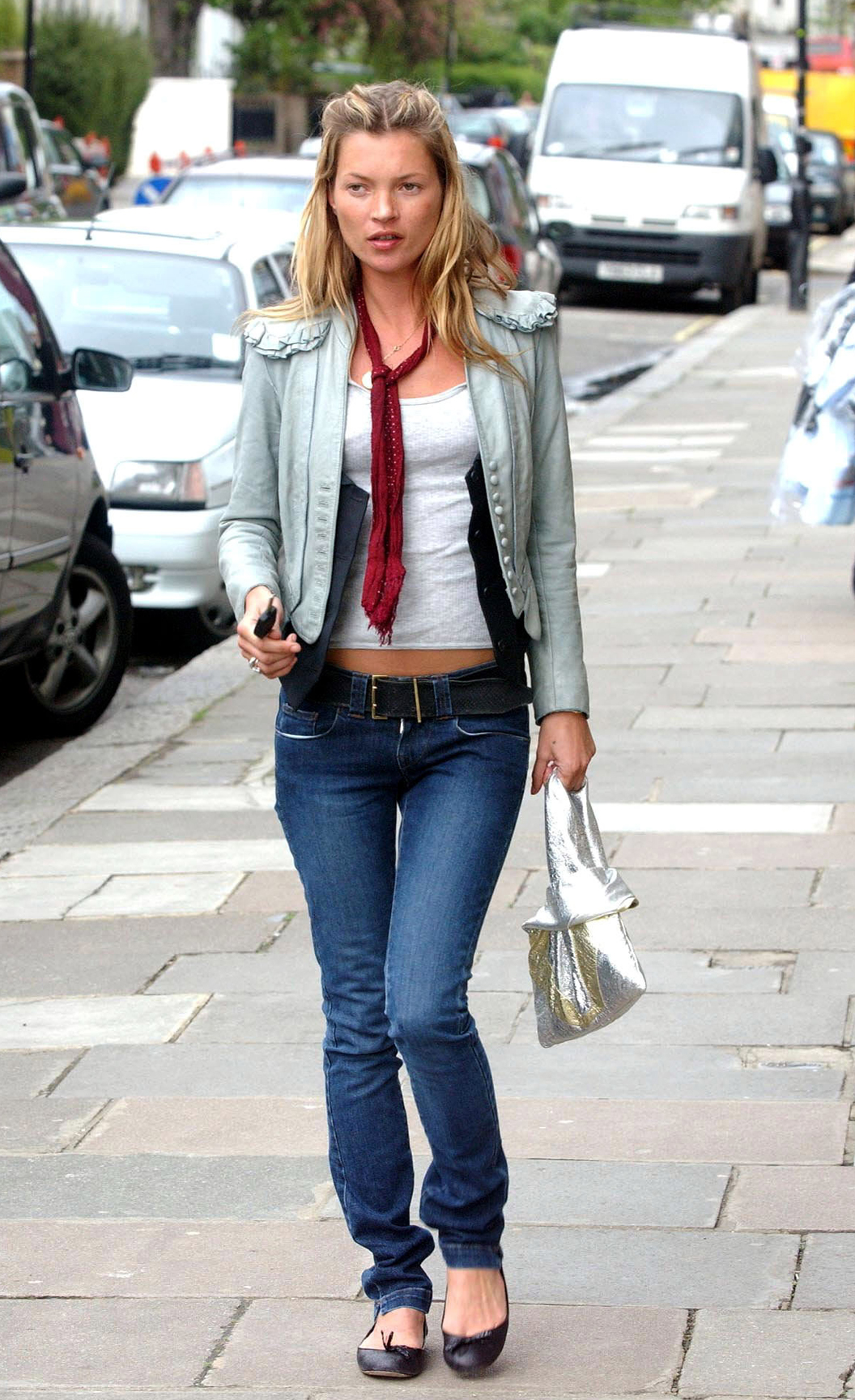
It also became something else. As the ballet flat became commercially valuable, the market filled with versions that bore no relationship to the leather construction that had defined the original shoes. Bonded leather, synthetic uppers, glued soles, and price points that made the shoe disposable rather than long-lasting.
2026: the shoe returns again
The current resurgence began in earnest through 2024 and accelerated sharply through 2025 and into 2026. The shoe is back on the runways at Chanel, Simone Rocha, Molly Goddard and The Row.
What to look for in a modern pair
Two hundred years of history makes it possible to identify what separates a ballet flat made to last from one made to sell.
Leather quality is the first marker. Full grain leather, which retains the original surface of the hide, ages well and conforms to the foot over time. Corrected grain leather, which has had its surface sanded and a synthetic finish applied, looks acceptable when new but cracks and degrades faster. Bonded leather, made from leather scraps glued together, is not leather in any meaningful sense and should not be sold as such.
Sole construction matters next. A good quality leather should last years and be able to be resoled several times. Insole and lining are where construction quality often hides. A leather-lined insole breathes, moulds to the foot, and lasts for years. A synthetic lining traps moisture, breaks down faster, and is the source of most of the discomfort people associate with cheap flats.
The country and method of manufacture is a useful proxy for the above. Shoes made in small batches by makers who can explain their leather sourcing and construction process generally outlast shoes made anonymously at scale.
D'Arçé and the ballet flat
When we began making our Mary Jane ballet flats several years ago, we chose to honour the tradition of ballet flats from the past. We chose vegetable-tanned calf leather from Spain for the suppleness that would allow it to mould to the wearer's foot with the construction reference point for the ballet flats being the Georgian and Regency slipper: an unstructured, soft-soled shoe that moves with the foot rather than against it.
That principle shapes the way the shoes are built. There are no thermoplastic inners, no heel counters, no synthetic stiffeners hidden inside the construction. The shoes are 100% leather, made using traditional techniques. The foot is not being held in place by plastic structures that fail over time and break down the inside of the shoe. A thermoplastic heel counter compensates for thin or weak hide. Removing it means the leather has to be strong enough, supple enough and well-tanned enough to hold its own shape and to support the wearer's foot without rigid scaffolding. Our choice of 100% Spanish calf leather for both outer and inner is what makes that construction possible.

The ballet flat is back in the cultural foreground because the shape works, across slip dresses, midi skirts, and relaxed tailoring, in a way that heeled alternatives simply don't right now. What determines whether the shoe lasts past the season is what it is made of and how it is constructed, and that has been true of the ballet flat since 1810.